"国家要进步,语言要沟通..." If you grew up in Singapore during the 1980s, there's a good chance you can still hear the melody in your mind.
Those opening lyrics introduced one of the country's most recognizable public education campaigns. In 1979, then-Prime Minister Lee Kuan Yew launched the Speak Mandarin Campaign at Singapore Conference Hall with the slogan "多讲华语,少说方言" (“Speak more Mandarin, less dialect”). The goal was to encourage Chinese Singaporeans, whether Cantonese, Hokkien, Teochew, Hakka, or Hainanese, to adopt Mandarin as a common language while strengthening bilingual education nationwide.
A year later came the campaign's memorable theme song 《大家说华语》, composed in 1980 and famously performed by local songbird Dawn Yip (叶佩芬). Throughout the 1980s, it became almost impossible to avoid. It played on television, radio, in schools, and at community events, embedding itself into the memories of an entire generation.

The《大家说华语》, or Speak Mandarin Campaign. featuring Dawn Yip
Like many Singaporeans of that era, I never questioned why it was everywhere. It was simply part of growing up. Only decades later did I come to appreciate how significant that period really was.
I was fortunate to grow up at a time when Singapore's language landscape was transforming. At home, conversations flowed effortlessly between English and Cantonese with my extended family. School reinforced bilingualism, television increasingly reflected national language policies, and every year seemed to introduce another subtle shift in how languages were taught or encouraged.
Language learning in those days looked very different from today. It meant carrying dictionaries, writing pages of Chinese characters until your wrist ached, memorizing chengyu, practicing oral examinations with classmates, and hoping your teacher approved of your composition. On several memorable occasions, some of my Chinese compositions were displayed on the school notice board as an affirmation that all the hours of practice had paid off.
The experience was slower and perhaps more frustrating at times than language learning today, but it was also deeply immersive. Looking back, the education system was never simply teaching us another language but teaching us how to belong to multiple worlds at once.
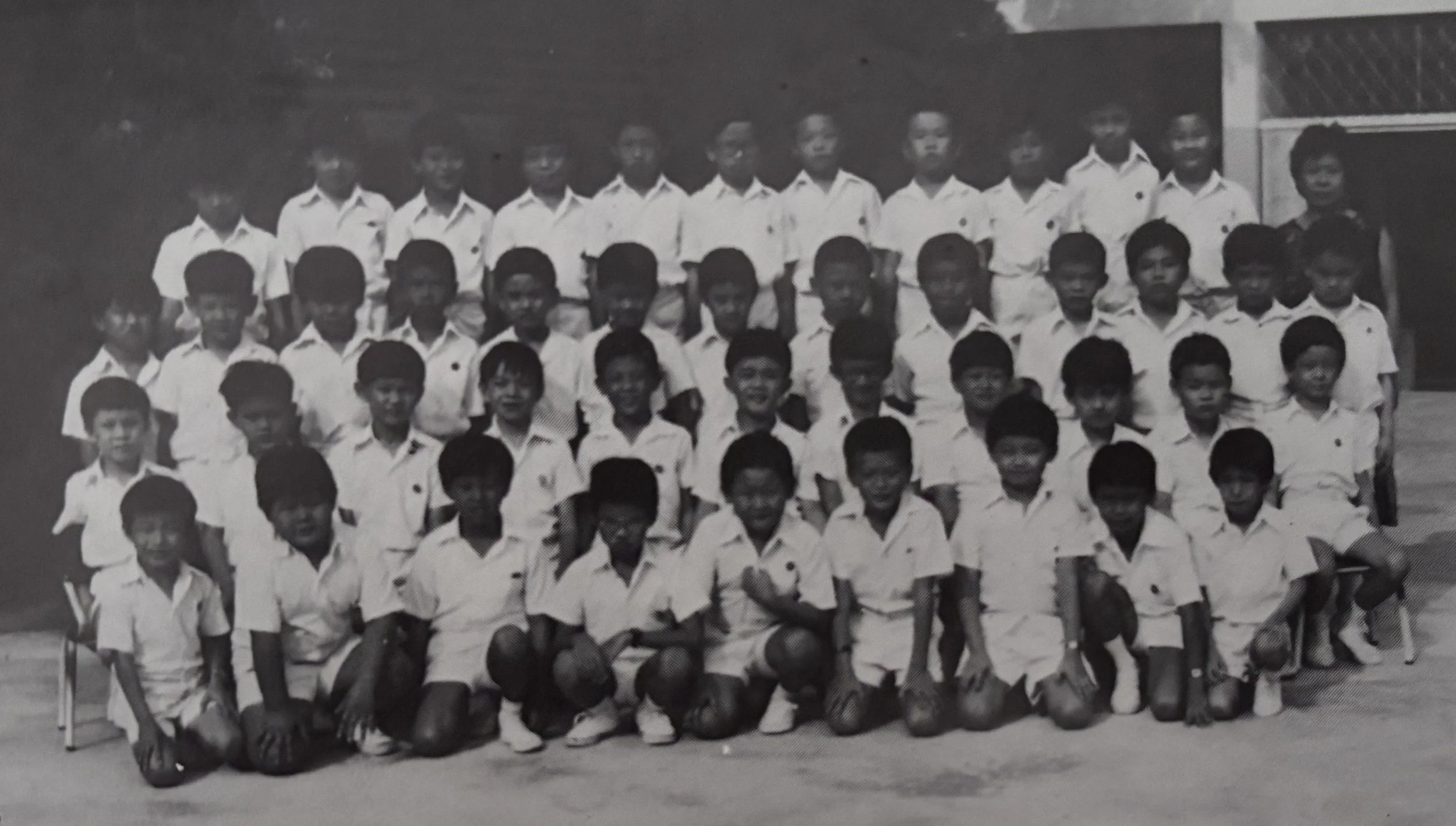
Growing up in the 80s in Singapore was a unique experience
English, and increasingly Mandarin, have opened doors to Singaporeans internationally while providing a common language across our multicultural society. At the same time, our mother tongue languages connected us to our families, literature, traditions, and identities. The balance has never been perfect, but it became one of Singapore's defining educational strengths.
The introduction of the Chinese Language Elective Program (CLEP) in 1990 created new opportunities for students with a passion (or perhaps a push from the parents) for the Chinese language as an elective beyond the standard curriculum.
Its success has allowed the initiative to continue evolving. Beginning in 2027, the Ministry of Education will expand its language elective programs across more secondary schools and junior colleges, giving more students opportunities to study Chinese, Tamil, and Malay beyond the standard curriculum. Participants will gain greater exposure not only to language itself but also to literature, history, culture, and overseas immersion experiences.
For students today who have a passion for languages, these programs represent a remarkable opportunity. They encourage curiosity, cultural understanding, and meaningful engagement beyond the classroom. In many ways, they acknowledge something educators have increasingly recognized over the years: language learning flourishes when students experience a culture, not simply study its vocabulary.
Artificial intelligence is also fundamentally changing how languages are taught and learned. Students can now practice conversations with AI tutors that never grow impatient, receive personalized feedback on pronunciation within seconds, and immerse themselves in authentic content from virtually anywhere in the world. Instead of waiting days for corrections, learners receive immediate guidance tailored to their own proficiency levels.
Singapore's education system is embracing this change as well. The Ministry of Education recently announced the rollout of its AI Essay Marking System (AIMS) for Chinese language teachers. By automating routine marking tasks such as grammar, spelling, and sentence structure, teachers gain more time to focus on something AI still struggles to evaluate fully: creativity, originality, expression, and the ability to communicate ideas with authenticity.
As Singapore and our society continue to evolve, language learning remains an essential life skill. In an increasingly connected world, speaking another language opens doors to careers, international partnerships, regional understanding, and deeper human relationships. As businesses become more global and societies become more interconnected, bilingual and multilingual communication continues to grow in value, not simply because it helps people exchange information but because it builds trust.
Technology, of course, has accelerated language transformation in ways few of us could have imagined. For instance, translation technology has become more accurate, and AI continues lowering the barriers to language learning. Yet, this is hardly an excuse to stop learning another language. If anything, the opposite is true. The easier technology makes communication, the more valuable genuine cultural understanding becomes.
Anyone can translate a sentence. But far fewer people can understand the humor behind it, the historical references embedded within it, or the subtle differences that shape how the same message is interpreted across cultures.
Language has never been just about words. It’s always been about perspective. During this year's Mother Tongue Languages Symposium, Education Minister Desmond Lee reminded us that parents do not need to be perfect speakers to raise bilingual children. What matters most, he said, is effort and consistency.
Whether learning Mandarin at school, helping a child read their first storybook in their mother tongue, or picking up Spanish through an app at forty-five, progress has always belonged to those willing to keep showing up.
Language learning is ultimately a lifelong journey. While the tools continue to evolve, from television jingles and paper dictionaries to AI tutors and real-time translation, the purpose remains unchanged: to help us connect more deeply with our heritage, understand other cultures, and communicate with one another in ways that technology alone never can.

About the Author
Colin Drysdale is the Chief Strategy Officer with Flynde, a global company providing translation solutions to businesses of all sizes.
Discover the best-in-class translation solutions for your business. Trusted & certified for all languages with locations in Singapore, Switzerland & the USA. Flynde takes human translation strategies and uses advanced technologies to deliver them to our customers across our three business lines: Flynde for startups, Flynde for small businesses, and Flynde for corporations.
For more information, contact us at hello@flynde.com