
Before the Silk Road: How Ancient Southeast Asia Forged the World's First Global Trade Routes

Bert Nguyen
Associate Language Manager and Copywriter at Flynde
The story of global maritime trade is often told, starting with Chinese silk reaching Roman markets. But this narrative misses the beginning of the story by several thousand years. Long before the term "Silk Road" was ever conceived, the vast archipelago of Insular Southeast Asia was the actual engine of a burgeoning global exchange, pioneering the sea lanes that would one day connect hemispheres. These were not passive thoroughfares; they were the heartland of the ancient "Spice Routes," a dynamic network built by the region's own master mariners.
The Austronesian pioneers and the Jade Road
The history of long-distance sea trade in Asia begins not with external empires, but with the indigenous Austronesian peoples of Southeast Asia. As early as 2000 BCE, they established the Maritime Jade Road, a sophisticated network spanning over 3,000 kilometres that operated for three millennia. Centred on the trade of raw jade from Taiwan, this material was worked into distinctive ornaments in workshops across the Philippines, Vietnam, and Borneo, creating a shared material culture across a vast maritime space.

Lingling-o jewellery, dated Lingling-o artefacts, around 500 BCE, were brought from the Philippines archipelago to other regions via the Maritime Jade Road.
Source: Chaoborus
This was not an isolated phenomenon. By 1500 BCE, Austronesian sailors had established robust spice trade networks with India and Sri Lanka. This was a profoundly reciprocal exchange. They introduced key crops to South Asia, including coconuts, bananas, and the now-famous spices of cloves and nutmeg, which grew nowhere else on earth. In return, they brought back new goods and ideas. This evidence fundamentally reframes the historical narrative, positioning the region as the primary innovator of early maritime globalization.
The rise of the great thalassocracies
The dense trade networks pioneered by Austronesian sailors laid the foundation for the rise of powerful, centralized maritime empires. The Srivijayan Empire (7th-13th centuries) and its successor, Majapahit (13th-15th centuries), emerged as global powers by mastering these sea lanes.
These empires are best understood as thalassocracies - states whose power was projected through naval supremacy and the control of commerce, not the conquest of land. Based in Sumatra and Java, they leveraged their strategic position to control the world’s most vital maritime choke points: the Strait of Malacca and the Sunda Strait. Their dominance was so complete that it prompted the observation centuries later that, like what Portuguese adventurer Tomé Pires claimed, “Whoever is lord of Malacca has his hands on the throat of Venice".
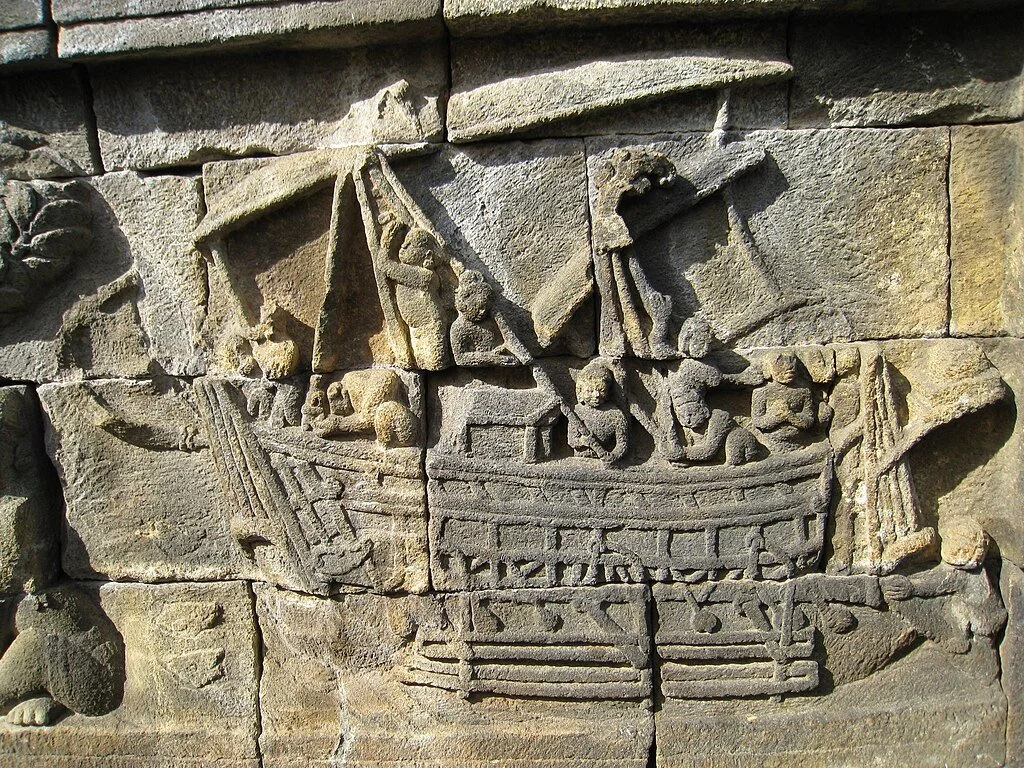
The Borobudur ship, native to Java, one of the most famous boats in Maritime Southeast Asia.
Source: Anandajoti
Srivijaya and Majapahit became the indispensable intermediaries for goods flowing between China, India, and the Middle East. They managed the lucrative trade in local spices, camphor, and sandalwood while controlling the flow of foreign goods like Chinese porcelain and Indian textiles. Their power was derived not from owning territory, but from controlling the flow of global commerce through a critical network node, a timeless lesson in maritime geopolitics.
A conduit for commerce, culture, and creed
More transformative than the exchange of goods was the flow of ideas. The Maritime Silk Road was the primary vector for the introduction of major world religions into the archipelago.
Hinduism and Buddhism arrived from India around the 4th century CE, readily adopted by local rulers who saw it as a way to integrate their kingdoms into a larger, cosmopolitan world of commerce. The region quickly became more than just a recipient of these faiths. The Srivijayan empire, in particular, evolved into a world-renowned center for Buddhist scholarship. The 7th-century Chinese monk Yijing famously advised fellow pilgrims to spend years studying in Srivijaya before proceeding to India, a testament to the region's intellectual and religious prominence.
Centuries later, Islam arrived peacefully through the same port cities with Muslim merchants, and local rulers converted to further integrate their kingdoms into the lucrative Indian Ocean trade network. In each case, the process involved creative adaptation, with new beliefs blending with local traditions to create unique cultural expressions.
The port cities of Insular Southeast Asia were multicultural crucibles where artisans, monks, and scholars from diverse civilizations met and mingled, sparking innovation and cultural exchange. The region's history is a powerful reminder that it has never been merely a crossroads, but a source—a place where the currents of global history were born and shaped.
COFFEE WITH BERT
This is to bring you the richness of global traditions straight to your desktop.
Join Bert Nguyen - one of our copywriters, as we journey beyond borders—celebrating diversity, bridging cultures, and uncovering the stories, places, and people that make our world so fascinating.
