Why Language Learning Still Matters in the Age of AI
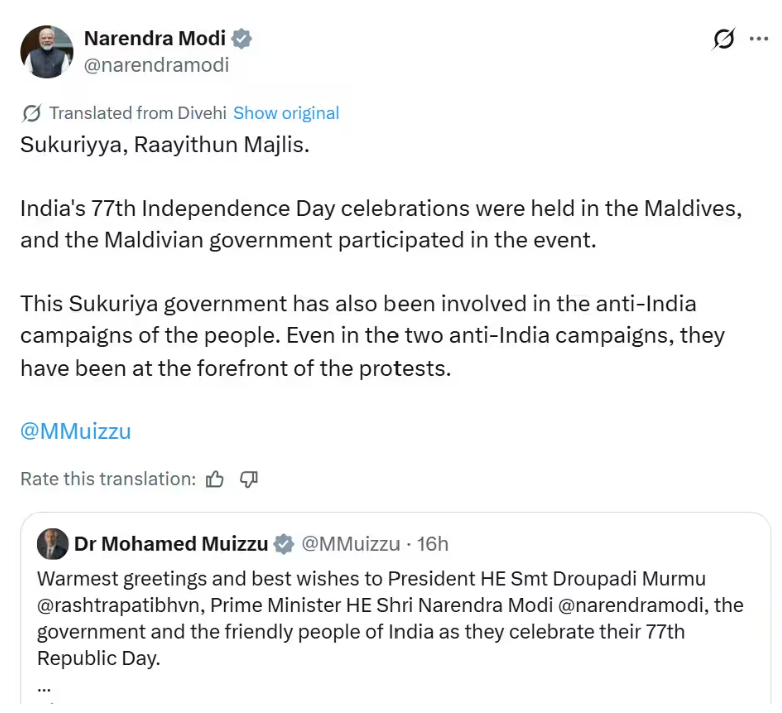
Just last month, an AI translation tool misrendered a friendly January 26 Republic Day message between India’s Prime Minister Narendra Modi and the President of the Maldives, transforming goodwill into an unintended political attack. Similarly, in February 2025, NHK, Japan’s national broadcaster, made headlines when AI-generated subtitles referred to the disputed East China Sea islets as the “Diaoyu Islands,” rather than Japan’s preferred “Senkaku Islands.”
While linguistically accurate in a literal sense, such phrasing triggered diplomatic embarrassment, highlighting the pitfalls of relying solely on AI in sensitive political contexts. These incidents underscore the stakes: translation errors are not merely inconvenient but can escalate tensions and influence international relations, even when promoting political peace is especially critical.
Dr. Daniel Chan, assistant dean at the Faculty of Arts and Social Sciences and senior lecturer of French at the Centre for Language Studies, National University of Singapore, emphasizes: “Much is lost if we fail to master the cultural context and nuances behind other languages.” Automated translations can provide words, but they cannot reliably convey intent, sensitivity, or social context; qualities essential to diplomacy.
Consider something as seemingly simple as “I am sorry.” Across languages, its meaning and implications vary in nuanced ways. In French, je suis désolé(e) expresses sympathy, while je m’excuse is an explicit apology. Spanish differentiates lo siento (sorrow) from perdón or discúlpame (requesting forgiveness). Japanese and Korean languages encode social hierarchy in apology forms, with different expressions depending on status and degree of responsibility. German separates es tut mir leid (regret) from ich entschuldige mich (formal apology). AI may suggest equivalents, but it cannot intuit the subtle emotional, social, or political weight these phrases carry in real-world interactions.
With geopolitical tensions rising worldwide, media organizations cannot afford to fuel political tensions from unchecked AI translations. AI tools can assist, but the final judgment must rest with humans: editors, professional translation companies, and fact-checkers who understand the stakes of misrepresentation.
In many ways, media outlets bear a responsibility to ensure that what is communicated across languages is not just accurate but contextually sensitive and therefore have a duty to prevent inadvertent escalation of conflicts, whether through mistranslations, missing nuance, or overlooking cultural sensitivities.
For the broader public, language learning is no longer just an academic exercise but a political necessity. For journalists, diplomats, and international organizations, understanding both the words and their context is critical. It ensures that statements meant to convey peace or cooperation are not accidentally framed as provocations. As British psycholinguist Frank Smith observed, “One language sets you in a corridor for life. Two languages open every door along the way.”

About the Author
Colin Drysdale is the Chief Strategy Officer with Flynde, a global company providing translation solutions to businesses of all sizes.
Discover the best-in-class translation solutions for your business. Trusted & certified for all languages with locations in Singapore, Switzerland & the USA. Flynde takes human translation strategies and uses advanced technologies to deliver them to our customers across our three business lines: Flynde for startups, Flynde for small businesses, and Flynde for corporations.
For more information, contact us at hello@flynde.com