
Once Upon a Humanity: What The Iconic Opener Reveals About Our Love for Storytelling
We are often described as "storytelling animals," and for good reason. Every culture on earth utilizes narrative to explain its origins, defines its moral compass, and preserves its collective memory. Yet, before a story can truly begin, it requires a "threshold," a linguistic signal that invites the audience to step out of ordinary time and into the realm of the imagination.
While the phrase "once upon a time" is ubiquitous in the West, a look at global opening formulas reveals a deep map of cultural values, environmental history, and social dynamics.
The cognitive airlock
Psychologically, these opening phrases serve as a "distancing mechanism". By placing a story in a "time far removed," the narrator creates a non-threatening space where listeners can process complex emotional truths or social taboos without the immediate anxiety of everyday reality.

“Once upon a time” is a “in-between” space that separates reality and the world of strorytelling.
In anthropology, this is known as a "liminal" state, or the "in-between" space where social hierarchies can be temporarily suspended, and new perspectives can emerge. Whether you are a professional storyteller or a corporate leader, these thresholds signal that we are moving from "fact-sharing" to "meaning-making".
The Gutenberg effect
The phrase "once upon a time" did not spring into our vocabulary exactly as we know it. Its roots reach back to Middle English, appearing as "Onys uppon a day" in the 1380 poem Sir Ferumbras and "once on a time" in Geoffrey Chaucer’s The Canterbury Tales in 1385.

The popularity of “Once Upon A Time” is much thanks to the invention of the modern printing technique by Johanne Gutenberg.
However, the global persistence and standardization of the phrase were driven by the rise of print media and 19th-century children's literature:
Translators as Gatekeepers: In 1729, Robert Samber translated Charles Perrault's French il était une fois ("there was one time") as "once upon a time". Similarly, Edgar Taylor used the phrase in 1823 to translate the German es war einmal for the Brothers Grimm.
The Andrew Lang Influence: Between 1889 and 1910, the Victorian folklorist Andrew Lang published his Color Fairy Books, which collected over 400 stories from around the world. Lang’s collections were so popular that they essentially "colonized fairyland," establishing a uniform English style that persists today.
The Power of Repetition: As written books became cheaper and more accessible, these specific opening formulas became the definitive marker of the genre, replacing more fluid oral traditions.
A verbal mirror of cultures
When we look beyond the English-speaking world, the variety of opening formulas is staggering, each revealing something unique about the culture that birthed it:
The Ontological Paradox (Arabic, Farsi, Turkish): Stories often begin with "There was and there was not" (ān yā mā kān). This phrase immediately challenges the binary of existence, signaling that the story’s "truth" is emotional and philosophical rather than historically literal. There are also longer versions of this. For example, in Classical Arabic, the phrase is كان يا ما كان،في قديم الزمان، وسالف العصر والأوان / ān yā mā kān, fī qadīmi-z-zamān, wa-salifi-l-‘aṣri wa-l-’awān... It reads “there was, oh what there was (or there wasn't) in the oldest of days and ages and times…” Wait until you see the full Turkish version at the end of this article.
The Ecological Anchor (Korea): The whimsical phrase "Back when tigers used to smoke" (호랑이 담배 피우던 시절에… / Horangi dambae piudeon sijeol-e) refers to a prehistoric, simpler era when animals and humans were perceived as indistinguishable. It reflects a time of social equality where even a tiger might possess the yangban (aristocratic) dignity of a pipe.
The Social Contract (Haiti): In Haitian tradition, a storyteller shouts "Cric?" and the audience must respond "Crac!" to indicate their readiness. This ensures that storytelling is a participatory, democratic act rather than a passive experience.
The Geographical Distance (Slavic and Indian): Slavic tales often begin "Beyond seven mountains and seven forests," while Indian stories might reference "seven rivers and seven seas". This use of the number "seven" highlights a long history of intellectual exchange between Asia and Europe.
Indigenous traditions
For many Indigenous American tribes, the Western linear structure of "beginning, middle, and end" is an imported concept. Traditional Lakota or Navajo stories are often nonlinear and circular, mirroring the "Winter Count" mind maps painted on buffalo robes.
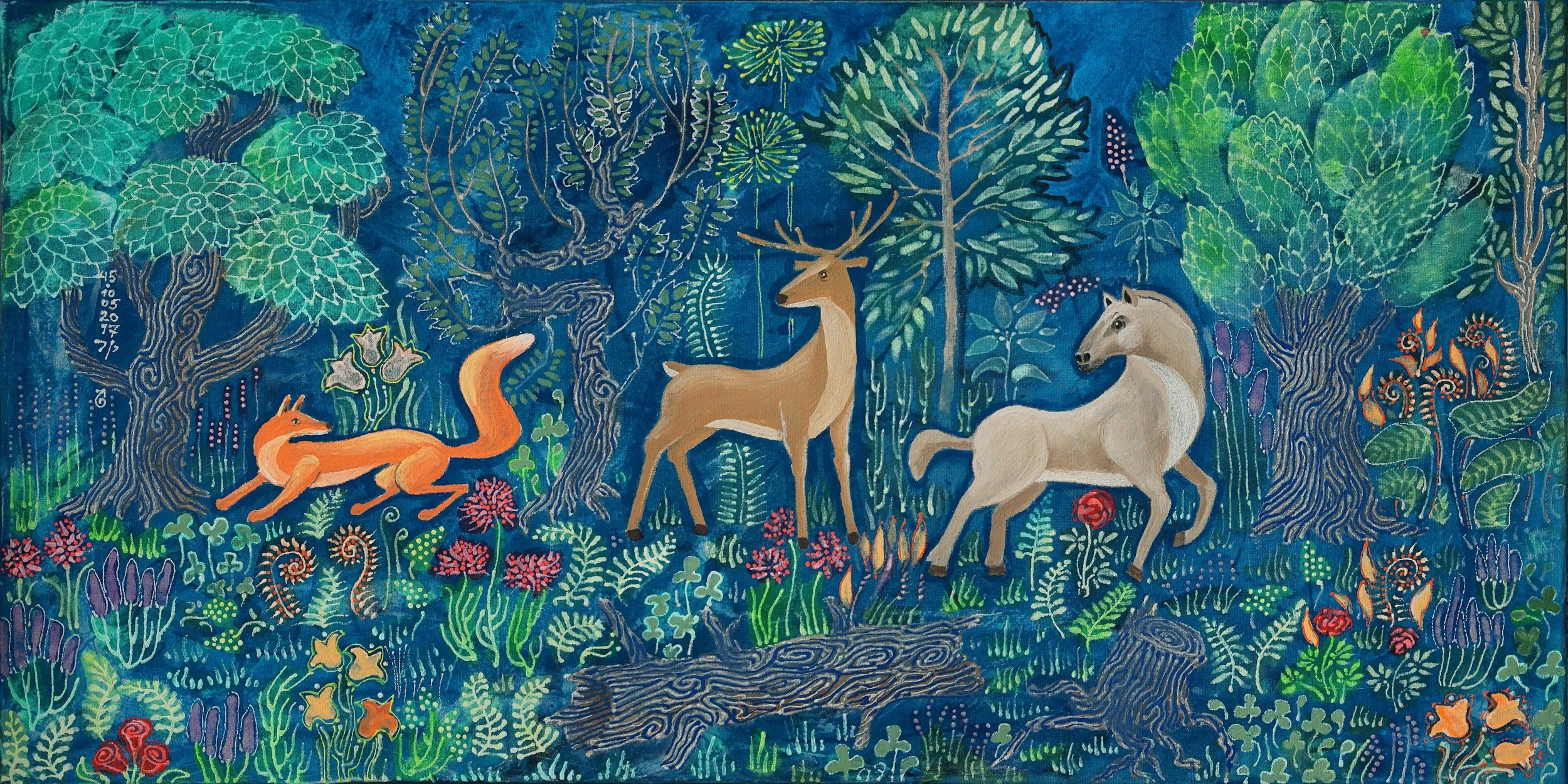
“Once Upon A Time” not only invites readers into a fantasy realm but also exposes the cultural beliefs of different societies.
In these cultures, the "opening" of a story is often tied to seasonal rituals; for the Oglala Lakota, an indigenous group in South Dakota (US), many stories are strictly forbidden until the winter snows arrive, ensuring they are shared in the proper sacred context. Today, revitalizing these native languages, like through dubbing Star Wars into Navajo, is a vital act of cultural sovereignty.
In an era of digital noise, the "formula" remains a powerful tool for connection. When a storyteller, whether in a boardroom or a classroom, invokes a threshold, they are doing more than starting a speech.
They are lowering resistance. Indeed, formulas like "tigers smoking" or "there was and was not" hook curiosity and smooth over skepticism. Meanwhile, the transition of “once upon a time” and its variations significantly help build a sense of community, which is essential to storytelling. Participatory frames like the Haitian "Cric? Crac!" reinforce social bonds and mutual trust. In addition, these phrases act as "memory anchors," keeping ancient wisdom alive in a rapidly changing world. Ultimately, these global "once upon a times" remind us that while our specific traditions differ, our need for stories to explain, heal, and connect is a universal human constant.

About the Author
Bert Nguyen is a Copywriter with Flynde, a global company specializing in translation solutions for businesses of all sizes.
Discover the best-in-class translation solutions for your business. Trusted & certified for all languages with locations in Australia, Singapore, Switzerland & the USA. Flynde takes human translation strategies and uses advanced technologies to deliver them to our customers across our three business lines: Flynde for startups, Flynde for small businesses, and Flynde for corporations.
For more information, contact us at hello@flynde.com