
Why the World’s Workplaces are Beginning to Sound Different
From Singlish in Singapore offices to Spanglish in Texas schools, hybrid languages are quietly reshaping how global companies communicate and what fluency means in a multilingual economy.
For decades, the ideal of professionalism carried an implicit linguistic rule: speak the standard language. In boardrooms, customer meetings, and corporate emails, polished English, or its local equivalent, was often viewed as the currency of competence.
But listen closely in a logistics office in Singapore, a school district in Texas, or a startup in Miami, and another reality emerges.
A Singaporean manager might tell a colleague, “Can settle by today or not?” A bilingual outreach worker in Austin may switch fluidly between English and Spanish while speaking with families: “If they start throwing in more English, I’ll also throw in more English,” as one Texas educator described it. Across continents, hybrid languages once dismissed as informal, incorrect, or unsuitable for work are increasingly functioning as tools of efficiency, identity, and inclusion.
The rise of Singlish, Spanglish, and other blended dialects signals more than casual speech habits. Linguists say they offer a real-time glimpse into how cross-cultural, multilingual, and even global communication strategies are evolving in workplaces shaped by migration, globalization, and digital connectivity.
When workplace language becomes cultural identity
A recent study by Singapore’s Institute of Policy Studies, reported by The Straits Times, found that more people in Singapore use Singlish more frequently in daily life and at work than a decade ago. Over half of respondents said that Singlish is an important part of Singaporean culture, while younger Singaporeans increasingly view it positively. The findings challenge longstanding assumptions that Singlish (an English-based creole incorporating Malay, Mandarin, Tamil, and Chinese dialect influences) should remain outside professional settings.
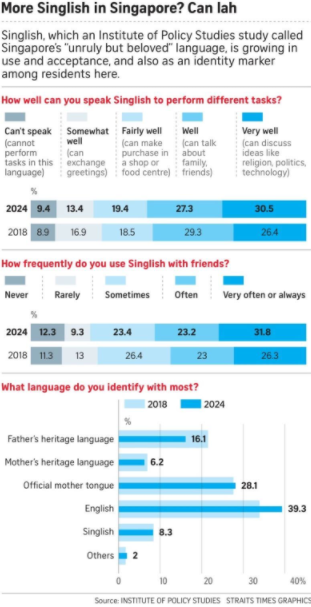
Researchers noted Singlish use had expanded into hawker centers, classrooms, family gatherings, and, increasingly, offices. Around 58% of people under 30 reported speaking Singlish well, compared with 46.8% in 2013. Among young adults, use with colleagues and friends has also risen.
“If you’ve been in school a bit longer and you’ve been told about standards in terms of language and what’s expected, you might be more critical about how language is used,” observed researcher Dr. Mathews Mathew in comments reported by The Straits Times. Younger Singaporeans, however, appear less concerned with those distinctions.
For many, Singlish offers something formal English cannot: familiarity. It can soften hierarchy in workplaces where regional diversity already requires constant code-switching. A phrase like “Can or not?” may communicate urgency, friendliness, and local understanding simultaneously, nuances difficult to replicate through standard business English. The result is a tension increasingly visible in multinational firms operating in Asia: maintaining global brand communications while remaining locally authentic.
Spanglish: not broken Spanish, but something new
Thousands of miles away, a similar linguistic negotiation is underway.
In Texas, Spanglish (the blending of Spanish and English) has become common among bilingual communities. The phenomenon is widespread enough that 63% of Latino Americans report speaking it at least occasionally, according to research cited by the BBC. For Yamilet Muñoz, a bilingual professional in Austin, switching between languages is instinctive.
“It’s like a rite of passage — we are making what we heard growing up into our own thing,” she told the BBC. “It’s very natural to use.” Muñoz described Spanglish as a way of integrating cultures rather than abandoning one for another. In professional settings, it also serves practical purposes: helping people feel comfortable, ensuring understanding, and reducing social barriers.

Linguists increasingly reject the idea that Spanglish reflects linguistic deficiency. “It's not incorrect at all,” Meghann Peace, a professor of Spanish in Texas, told the BBC. Rather, she described it as the outcome of sustained contact between English and Spanish.
Examples abound:
Lonche replacing the standard Spanish almuerzo for lunch
Troca instead of camioneta for truck
Correr para presidente, a direct translation of “run for president”
Researchers in Miami have documented even subtler shifts in which English phrases begin to mirror Spanish structure. Saying “get down from the car” rather than “get out of the car” reflects Spanish influence on English itself.
Language, in other words, does not simply borrow. It changes.
The business implications: what global companies may be missing
For international businesses, the emergence of workplace dialects raises uncomfortable questions. How should a multinational communicate internally across offices where employees switch naturally between formal English and local linguistic norms? How should marketing teams localize campaigns for audiences who inhabit multiple languages simultaneously? The answer may lie beyond translation.
Increasingly, organizations are investing in local-market communications, multilingual content strategies, and content localization designed to reflect how people speak rather than how dictionaries prescribe it. A campaign translated perfectly into standard Spanish may still feel distant to bilingual communities in southern Texas. Likewise, corporate messaging in Singapore that ignores local cadence may appear sterile or overly foreign. This shift is changing expectations around localization services, cross-border marketing, and multilingual marketing campaigns. Effective communication is becoming less about preserving one standardized language and more about navigating several at once.
The distinction matters commercially. Research consistently shows audiences respond more positively to content that feels culturally native, a growing priority for brands pursuing international expansion and APAC localization strategies.
The future of fluency
History suggests hybrid languages are not anomalies but precursors. After the Norman conquest in 1066, the French heavily influenced Old English. Over centuries, those mixtures helped create modern English itself. Today’s Singlish and Spanglish may represent similar processes unfolding in real time. They reveal something larger than vocabulary: how identity survives globalization.
In Singapore, saying lah at the end of a sentence can signal belonging. In Texas, eslei (a Spanglish adaptation of “slay”) can mark generational identity and cultural confidence. The workplace, once expected to erase these nuances, increasingly absorbs them instead. Perhaps the future professional is not someone who speaks one language flawlessly but someone who moves fluidly between several worlds, adjusting tone, dialect, and meaning depending on who is listening.
As economies become more interconnected, the most valuable communication skill may no longer be perfect English.
It may be knowing when perfect English is not the language people trust most.

About the Author
Colin Drysdale is the Chief Strategy Officer with Flynde, a global company providing translation solutions to businesses of all sizes.
Discover the best-in-class translation solutions for your business. Trusted & certified for all languages with locations in Singapore, Switzerland & the USA. Flynde takes human translation strategies and uses advanced technologies to deliver them to our customers across our three business lines: Flynde for startups, Flynde for small businesses, and Flynde for corporations.