
The Eyes of a Boat: How Vietnamese Boat Eyes Reveals the Role of Faith in Business

Bert Nguyen
Associate Language Manager and Copywriter at Flynde
Whether we are crossing the turbulent waters of the Mekong Delta in southern Vietnam or navigating the volatile currents of a global stock market, human beings share a fundamental need: the ability to "see" through uncertainty.
In the coastal and riverine regions of Vietnam, this need is physically realized through the ancient tradition of painting eyes on boats, a practice that transforms a wooden vessel into a sentient, protective entity. Meanwhile, in the abstract world of global economics, we use linguistic metaphors to give shape to concepts like success, poverty, and risk. By examining these two seemingly different worlds, we uncover a fascinating pattern in how humans use symbolic anchors to mediate their relationship with an unpredictable environment.
The boat as a living soul
In Vietnamese maritime culture, a boat is far more than a tool; it is a "spiritual creature" endowed with a soul. For fishermen, a boat without eyes is considered "blind," leaving it vulnerable to submerged hazards or malevolent spirits.
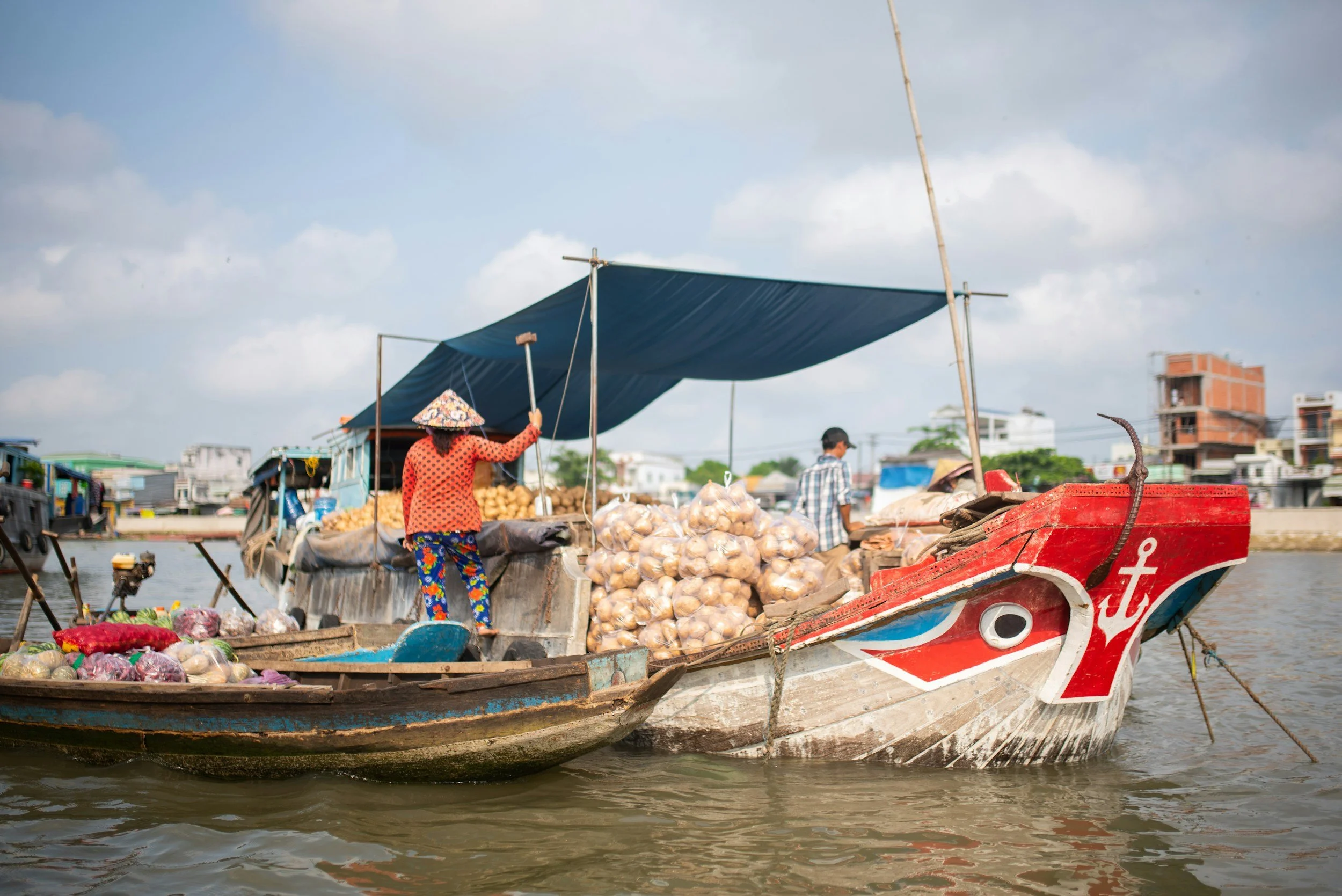
Vendor boats in a floating market in southwestern Vietnam
The act of "animating" the vessel occurs during the khai nhãn (Eye Opening) ceremony. This is a meticulous ritual performed on an auspicious day, involving a ritual table at the bow with offerings such as fresh flowers, fruit, tea, and alcohol. It is only when the master builder paints the pupils with sharp, distinct lines that the boat is believed to gain its "soul" and the ability to protect its crew.
The regional gaze
Interestingly, you can often tell where a boat comes from simply by looking it in the eye. These stylistic variations function like regional dialects :
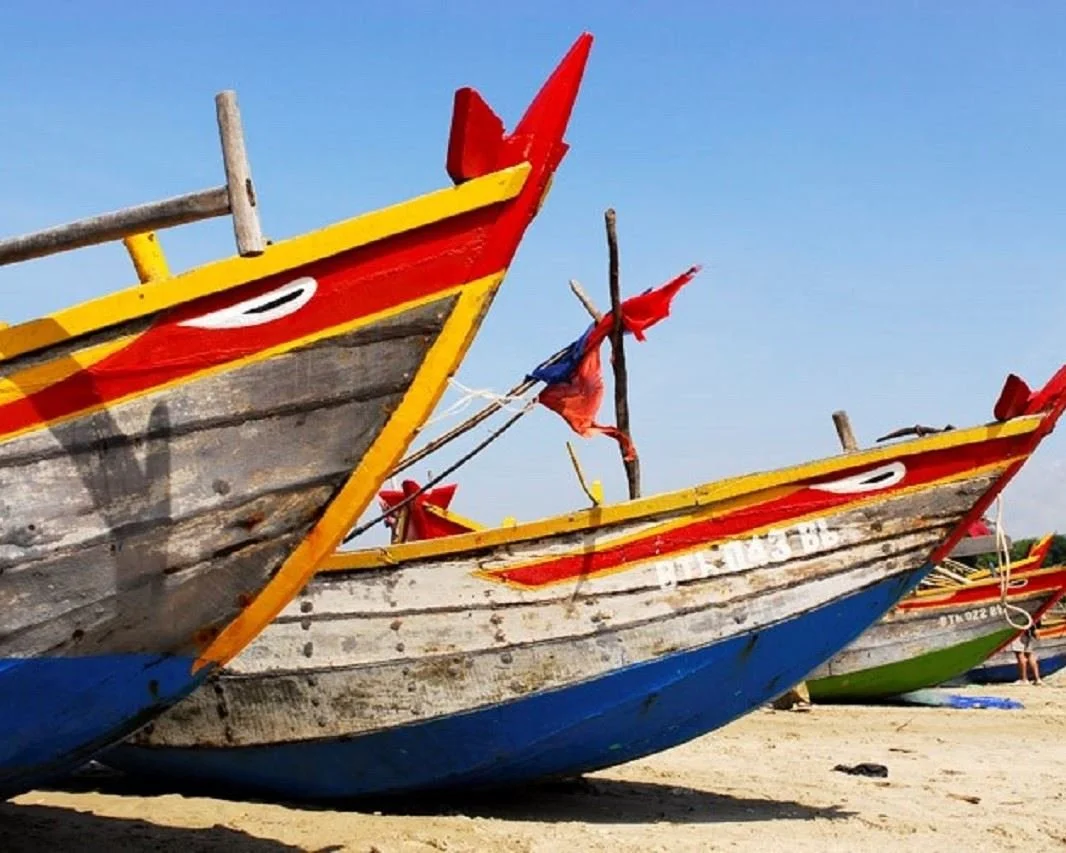
Some boats from the Central Coast of Vietnam
The Mekong Delta: Eyes here are typically large, almond-shaped, and gentle, reflecting a harmonious relationship with the fertile riverine landscape. Noticeably, junk boats in An Giang, a northwestern province in the region, often feature elliptical eyes with small pupils positioned toward the front, explicitly mimicking the anatomy of local fish.
The Central Coast: In regions facing fierce storms, the eyes are often round, sharp, and fierce, asserting the crew's determination to overcome nature.
From the waterways to the spreadsheets
Because the eyes are the soul of the ship, they are protected by strict taboos. Strangers are forbidden from touching a boat’s eyes for fear of "blinding" the vessel or bringing bad luck to the catch. During repairs, the eyes are carefully covered with a clean cloth so the boat’s spirit isn't "startled" by the trauma of the maintenance work.
While modern steel ships rely on radar, our modern economic language remains deeply tethered to the sea. In English, one may say "finance is fluid." In Vietnamese, it’s“tiền vô như nước” (money flows in like water). Basically, the metaphor of water humbly dominates our perception.
We speak of "liquidity," "cash flow," and "pumping" money into the market. When the economy struggles, homeowners may find themselves "underwater," and businesses try to "stay afloat". This linguistic mapping allows us to process the abstract complexities of capital by comparing them to the familiar dynamics of water.
Integrity vs. The "smell" of money
Finally, our symbolic systems impose moral judgments. In Vietnamese culture, integrity is often prioritized over material gain: "Đói cho sạch, rách cho thơm" (Be clean despite hunger, scented despite poverty). This contrasts sharply with the more utilitarian French proverb "L'argent n'a pas d'odeur" (Money has no smell), suggesting that the value of currency is independent of its, potentially dishonest, source.
The tradition of painting eyes on boats and the use of maritime metaphors in business are two sides of the same cognitive coin. Both provide us with a sense of agency and predictability in the face of the unknown.
Whether we are painting a pupil on a wooden prow to ward off sea monsters or discussing the "Blue Ocean" strategy to find untapped markets, we are seeking the vision necessary to survive and thrive. In a world of constant flow, these symbolic anchors ensure we don't just drift. Instead, we navigate.
COFFEE WITH BERT
This is to bring you the richness of global traditions straight to your desktop.
Join Bert Nguyen - one of our copywriters, as we journey beyond borders—celebrating diversity, bridging cultures, and uncovering the stories, places, and people that make our world so fascinating.
